Oil Tank Removal in Lansdale, PA: The Safety Questions You Should Ask Before Anyone Cuts Into It

On this page
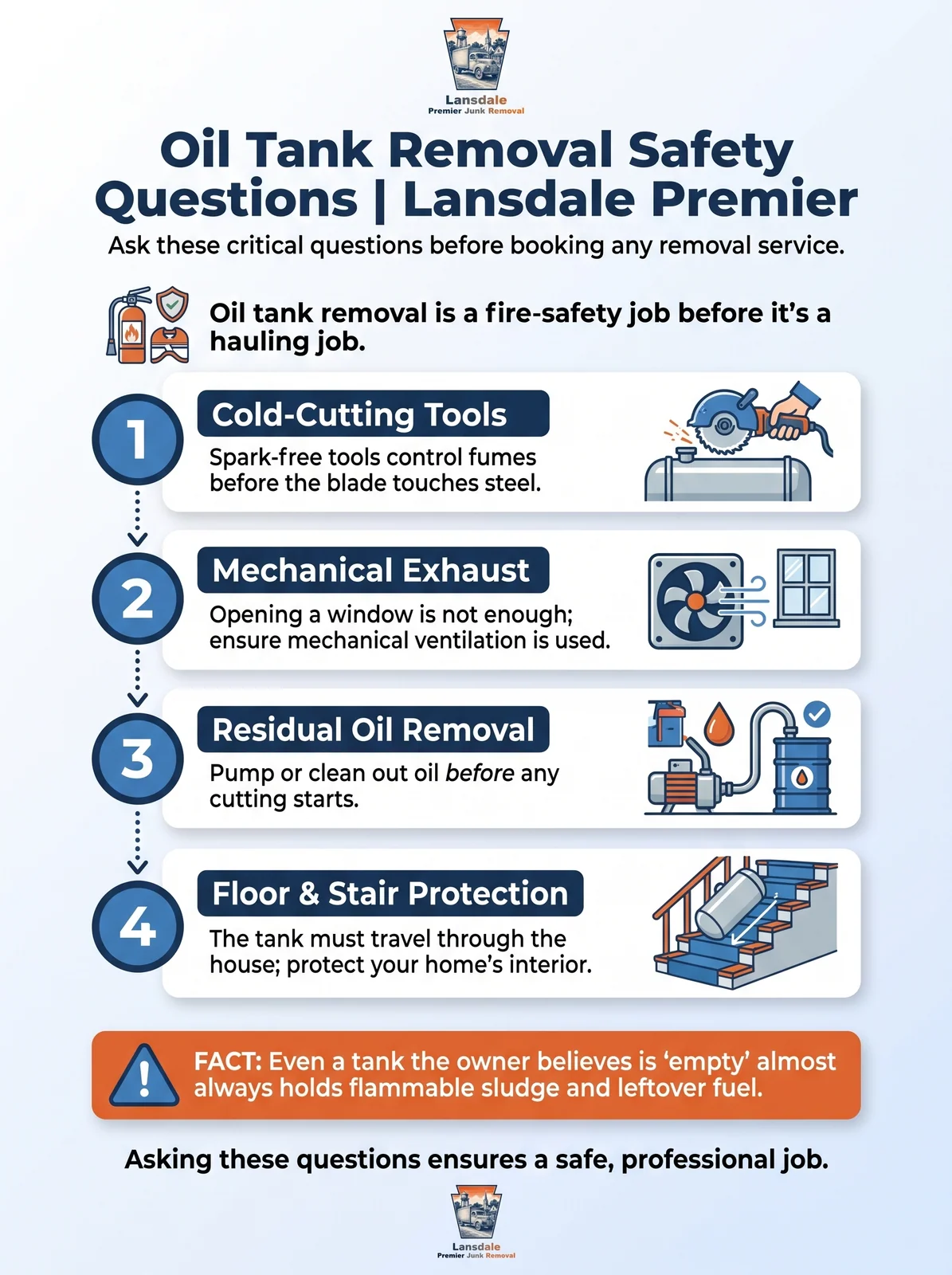
Oil tank removal in a basement is a fire-safety job before it’s a hauling job. Whoever does it should run cold-cutting tools — spark-free — and control fumes before the blade touches the steel. Residual oil at the bottom of a tank someone calls ’empty’ is still flammable. The questions below come from a real call Lansdale Premier Junk Removal took on an above-ground basement tank, and they’re worth asking before you book anyone.
Before you call anyone, here’s what actually matters:
- Cold-cutting tools remove sparks from the equation — the main ignition risk near a fuel tank.
- Opening a window is not the same thing as mechanical exhaust; ask which one you’re getting.
- Residual oil should be pumped or cleaned out before any cutting starts, not after.
- A tank with no basement exit travels up through the house, so floor and stair protection matters as much as the cutting itself.
- Tank removal pricing is published, and jobs outside the core service area carry a stated travel fee.
Why an Oil Tank Isn’t Just Another Heavy Item
An oil tank sitting in the corner of a basement looks like a piece of furniture nobody wants anymore. It isn’t. Even a tank the owner believes is empty almost always holds a layer of sludge and leftover fuel at the bottom, and that residue keeps giving off flammable vapor long after the burner stopped running.
It needs one thing to become a problem: a spark.
Cut into the tank with a grinder or a torch and you’ve supplied exactly that. It’s close to the scenario one homeowner described almost word for word on the phone before booking her removal: she wanted to know whether the fumes could ignite and take the house with them. She wasn’t overreacting. She was asking the one question that actually determines how the job gets done.
Treating this as a simple haul-away, in our view, is the wrong starting point. It’s a safety job first. The disposal part is the easy half.
The Two Questions That Matter Most Before Cutting Begins
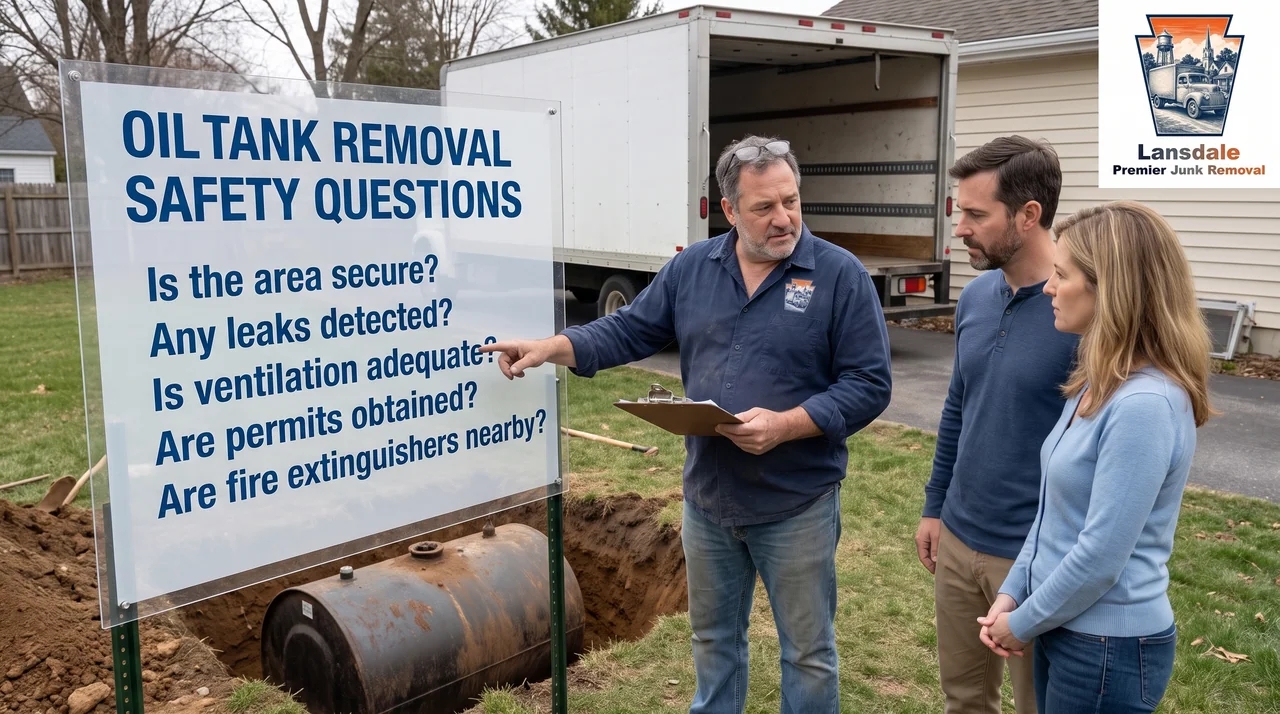
Two questions separate a careful crew from a risky one, and both came up in the same phone call that prompted this article. Ask them before anyone sets foot in your basement with a tool in hand.
Does the Crew Use Cold-Cutting Tools That Don’t Spark?
Cold-cutting is exactly what it sounds like: removing metal without a tool that throws sparks or generates cutting heat. Reciprocating saws fitted with metal blades, nibblers, and mechanical shears fall into this category — they shear or saw through steel rather than grinding or burning through it. A cutting torch or a standard angle grinder does the opposite job, by design.
For a tank that held fuel oil, that difference is the entire safety plan, not a detail inside it. Lansdale Premier Junk Removal keeps cold-cutting tools on hand specifically for this kind of job — torch work anywhere near residual fuel oil is a different risk category, and it’s not one worth taking to save ten minutes.
How Are the Fumes Controlled — Is the Basement Actually Ventilated?
This is the sharper question, and most homeowners don’t think to ask it. Opening a basement window lets some air move. It does not force fume-laden air out of the space the way a blower or an exhaust fan does, and the difference matters most in a tight basement with limited airflow.
| Approach | What It Does | When It’s Enough |
|---|---|---|
| Opening a window | Allows passive air exchange | Low residue, well-ventilated space, short cutting window |
| Mechanical (forced-air) exhaust | Actively pulls fume-laden air out of the room | Heavier residue, tight basement, longer cutting time, or any doubt |
Do you know whether your basement has an exterior door, or just the stairs down? That detail changes the answer. It’s more work to bring in forced-air exhaust equipment for a basement that might not need it, and it’s worth it the moment there’s any real doubt about how much residue is left in the tank.
Which approach is right for a given basement depends on how much residue is inside, how enclosed the space is, and how long the cutting will take. A crew paying attention makes that call from photos or an on-site look — not by assuming a cracked window is enough. If you’re not told which approach applies to your basement, ask.
Should the Tank Be Pumped and Cleaned Out First?
Yes, and the order matters. Pumping or cleaning out whatever oil and sludge remain happens before any cutting starts, not as an afterthought once the saw is already running. Less fuel means less vapor available to ignite. Full stop.
This step came up directly in the call that shaped this article — the homeowner asked whether cleaning the tank out was included before cutting, and it was. That’s the sequence that should be standard on any tank job, above-ground or in-basement.
Skip it, and the easiest risk reduction on the whole job gets skipped with it.
Above-Ground vs. In-Basement Tanks: What Changes
Most residential heating oil tanks in older Lansdale-area homes sit above ground, usually in the basement or a utility corner. The tank itself doesn’t change much from house to house. What changes is how it gets out.
Suppose the only basement access is a single stairwell that opens straight into the kitchen, with no exterior door and no walkout. Every section of that tank, once it’s cut down to a manageable size, travels through finished living space on the way out — there’s no way around it.
That was close to the exact situation in the call behind this article: the tank had to go up through the house stairs and out the back door, because there was no basement exit. Access like that changes the plan before a single cut is made. It determines how the tank gets sized down, which doorways need clearing, and how much floor protection goes down first.
What about underground or buried oil tanks?
A buried tank is a different job. It usually involves soil testing around the excavation site to check for leaked fuel oil, additional permitting, and sometimes remediation work beyond what an above-ground or in-basement tank requires. If your tank is buried rather than sitting above ground or in the basement, say so when you send photos — the assessment and the equipment needed aren’t the same.
Tanks like this don’t only turn up in homes where someone’s lived for forty years. They surface just as often during estate cleanouts lansdale pa, when a property changes hands after a death in the family, and in foreclosure cleanouts, where a house sat vacant with an aging oil system nobody serviced in years. The ownership situation changes. The safety questions don’t.
How the Removal Process Actually Works, Step by Step
Strip away the marketing and the actual sequence is short:
- Send photos of the tank and the basement — all sides, the base, and the path to the nearest exit.
- The crew reviews the photos and decides which tools are needed and whether the space needs forced-air exhaust before cutting.
- You get a written estimate back before anything is scheduled.
- On the day of the job, residual oil is pumped or cleaned out of the tank first.
- The tank is cold-cut into sections once the space is confirmed safe to work in.
- The sections are carried out along a protected path, and the area is swept before the crew leaves.
Once it’s out of the house, the tank itself gets scrapped as metal rather than landfilled — the same path as any scrap metal removal lansdale pa job.
Keeping Your Home Clean During the Carry-Out
A tank doesn’t exit a basement in one piece. Once it’s cut down, the sections still have to travel through your house if there’s no basement exit, and that means through hallways, up stairs, and past whatever furniture happens to be in the way.
Floor runners and stair protection go down before the first section moves, not after someone notices a scuff mark. Doorways get cleared ahead of time rather than negotiated mid-carry. And when the job is done, the path gets swept — that’s standard on a residential cleanout, not an upgrade you pay extra for.
It should never be an afterthought.
If the tank removal is part of a larger basement attic cleanouts lansdale pa project, the same floor-protection rules apply to everything else coming out of the house that day.
What It Costs and the Travel Fee for Outlying Jobs
Tank removal pricing is published, not negotiated at the curb. A standard removal, with no cutting or sealing required, runs around $150. Where the tank has to be cut down and sealed on site, the price climbs toward $1,000, depending on size, access, and how much work the carry-out itself takes.
| Scope of Work | Typical Price |
|---|---|
| Standard tank removal, no cutting needed | $150 |
| Cutting and sealing required on site | Up to roughly $1,000 |
This kind of job — cutting, sealing, and removing a fuel tank rather than just hauling furniture — falls under home improvement contractor work, not plain hauling. Lansdale Premier Junk Removal’s PA HIC #PA112494 registration covers exactly this category of job, and it’s worth asking any company you call whether they can say the same.
Jobs inside the core Lansdale-area footprint, in towns like junk removal hatfield pa and junk removal doylestown pa, don’t carry a travel surcharge. Farther out, a published travel fee of $25, $75, or $99 applies depending on distance, stated before you book rather than added to the invoice afterward. Locations further still, toward junk removal bethlehem pa, junk removal allentown pa, or junk removal reading pa, sit in a travel-fee zone and get quoted individually, with the fee disclosed either way.
Why a Photo-First Estimate Is the Safe Way to Quote This Job
None of the decisions above — which tools, whether the basement needs forced exhaust, how the carry-out route gets protected — can be made over the phone. They depend on what the tank actually looks like, where it sits, and how the house is laid out. That’s why photos come before a number, not after.
Lansdale Premier Junk Removal handles exactly this kind of job as part of its tank removal lansdale pa service, and the process starts the same way every time: photos in, assessment back, written estimate before anything is scheduled.
Before You Send Photos, Check This
Send photos of your tank and basement before booking anything. Call (267) 692-5528 or reach Lansdale Premier Junk Removal through the site, and get a written estimate back before a single tool leaves the truck.
Frequently Asked Questions
Can an “empty” oil tank still be dangerous to cut?
Yes. “Empty” usually means no fuel is being drawn from it, not that nothing remains inside. A layer of sludge and residual oil commonly sits at the bottom even after a tank stops being used, and that residue keeps releasing flammable vapor. Treat every oil tank as though it still has something in it until it’s confirmed clean.
What are cold-cutting tools, and why do they matter for oil tanks?
Cold-cutting tools cut metal without producing a spark or significant heat — reciprocating saws, nibblers, and mechanical shears fall into this group. Torches and standard grinders do the opposite, by design. Near a tank that held fuel oil, removing the ignition source is the entire point.
Do I need the basement ventilated before the tank is cut?
It depends on how much residue is in the tank and how enclosed the space is. Opening a window provides some passive airflow, but it isn’t the same as mechanical exhaust pulling fume-laden air out of the room. A careful crew makes that call based on photos or an on-site look, not by default assumption.
Is pumping or cleaning the tank included in the removal?
It should be, and it’s part of the standard sequence — residual oil gets pumped or cleaned out before any cutting starts. If a quote doesn’t mention this step, ask directly whether it’s included.
How far will the crew travel, and is there a travel fee?
Core Lansdale-area towns don’t carry a travel surcharge. Farther locations have a published travel fee of $25, $75, or $99 depending on distance, and jobs well outside that radius, including stretches toward Bethlehem, Allentown, or Reading, are quoted individually with the fee stated before booking.
Do you remove underground or buried oil tanks too?
Buried tanks are a different, more regulated process that can involve soil testing and additional permitting. Mention during the photo step whether your tank is buried rather than sitting above ground in the basement, so the right assessment gets applied from the start.
If there’s an oil tank waiting in your basement, the next step is simple: take the photos, send them in, and get the written estimate back before any tool comes out of a truck. Lansdale Premier Junk Removal can be reached at (267) 692-5528 for exactly that conversation.
Did this answer your question?
Thanks — that tells us what to fix.

About the author
Ryan Detweiler has been hauling junk in and around Lansdale since 2015. He runs Lansdale Premier Junk Removal from 5 Green St and still works the truck most days, quoting loads by the eighth of a truck — $150 for an eighth, $695 for a full load, $899 for the XL box. His pricing rule is simple: every fee we charge is on the pricing page before you book. The crew handles furniture, appliances, estate cleanouts, garage and basement clearing, hot tub and shed removal, and light demolition across Lansdale and Montgomery County, and donates or recycles what still has use left in it instead of sending everything to the landfill. The company is a Pennsylvania-registered home improvement contractor, HIC #PA112494. Same-day pickups get 20% off, and seniors always get 10%. Call or text (267) 692-5528.
All articles by this author →