On this page
Junk removal companies price by how much space your items take up in the truck, not by weight or by counting items. A “half load” means your stuff fills about half the truck bed — roughly $395 with current 2026 pricing. If you’re not sure which fraction your pile fits into, the fastest fix is to send photos and let the crew estimate the space before anything gets scheduled.
What to know before you book
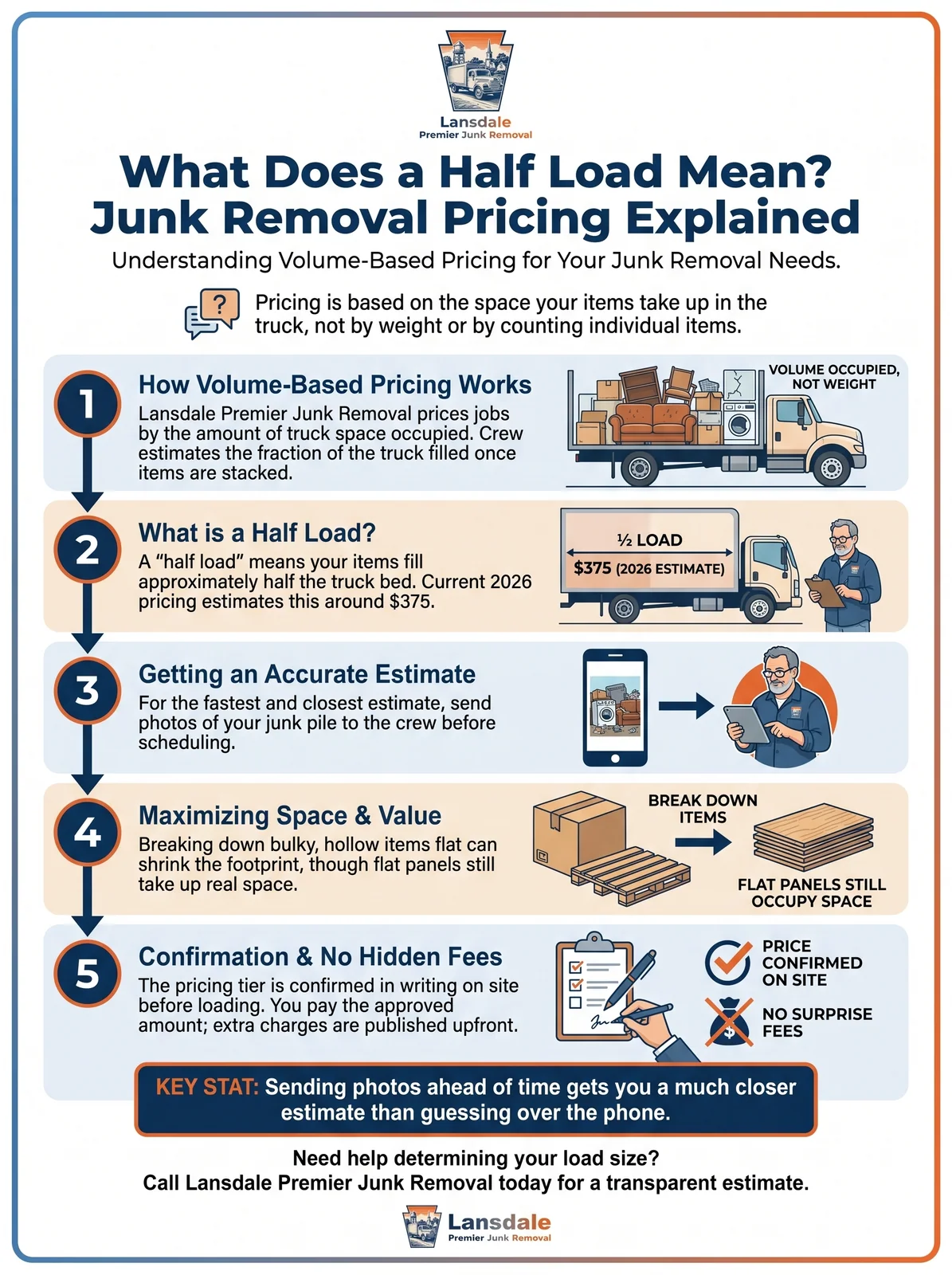
- Pricing is based on the space your items take up in the truck, measured in eighths, quarters, halves and full loads.
- Sending photos ahead of time gets you a much closer estimate than guessing over the phone.
- Breaking bulky, hollow items down flat usually shrinks the footprint — but flat panels of wood or MDF still take up real space.
- The tier is always confirmed in writing on site before anything is loaded, so the number you approve is the number you pay.
- Extra charges like travel fees or weight surcharges are published up front, not added as a surprise later.
How volume-based pricing actually works
Most junk removal companies, including Lansdale Premier Junk Removal, price jobs by the amount of truck space the items occupy — not by weight, and not by counting individual pieces. The idea is simple: a truck bed only holds so much, and the crew estimates what fraction of that space your load will fill once it’s all stacked and strapped in.
This is different from a per-item price list or a flat hourly rate. Two customers with the exact same number of items can end up with different quotes if one pile is bulky and awkward to stack while the other breaks down neatly. That’s why “how much stuff do you have” is really a question about shape and volume, not just quantity.
What each load fraction looks like
The fractions themselves — 1/8, 1/4, 1/2, 3/4, full truck — don’t mean much until you can picture what actually fills them. Here’s a plain breakdown, with the price list as it stands in 2026.
| Load size | Price | What it typically looks like |
|---|---|---|
| 1/8 load | $150–$160 | Our most common job — a couch, a couple of mattresses, or one cluttered corner of a garage |
| 1/4 load | $275 | A small set of furniture, a few appliances, or a modest closet clear-out |
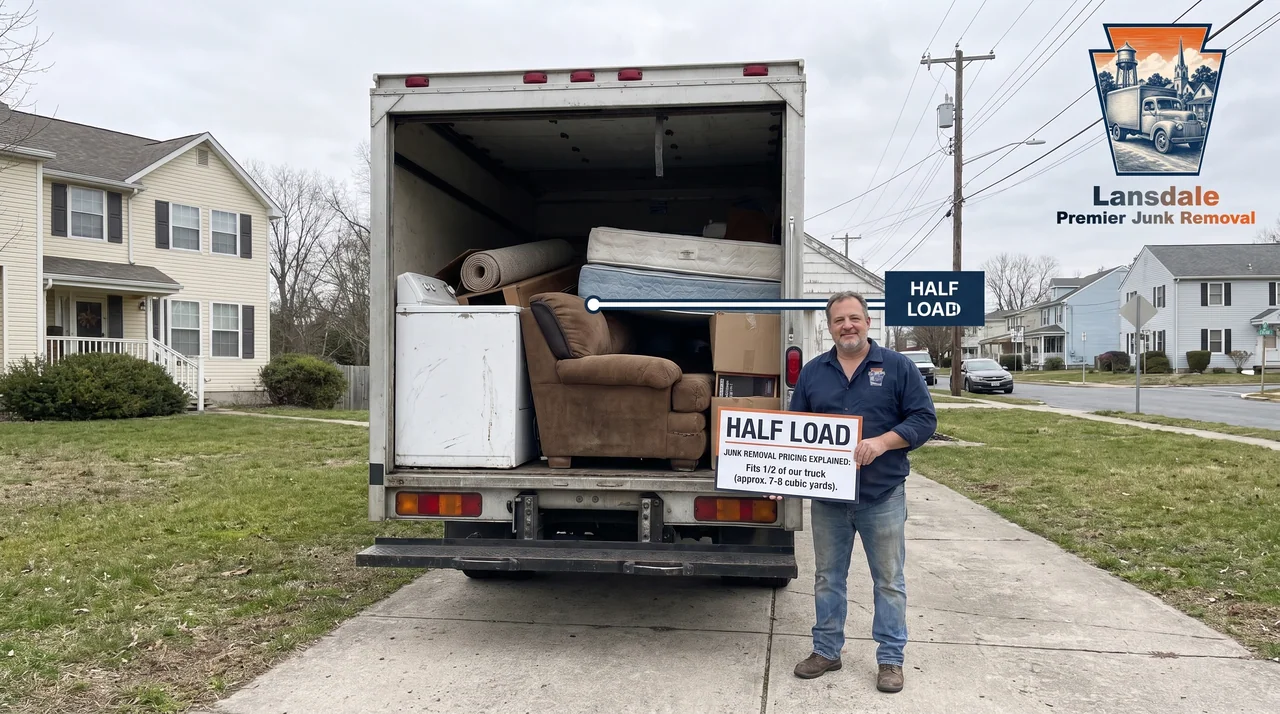
| 1/2 load | $395 | Roughly a small bedroom’s worth of furniture, or a partial basement or garage cleanout |
| 3/4 load | $525 | A multi-room cleanout, or a garage plus a shed’s worth of items |
| Full truck | $695 | A full garage, full basement, or the contents of a small storage unit |
| XL / big truck | $899 | A larger multi-room job or a property with more volume than a standard truck can hold |
For jobs that run past a single truck — think a full full house cleanout or a property with an unusually large volume of bulky items — pricing moves into multi-truck territory, generally $1,090 to $1,785 depending on how many loads it takes. If a job is genuinely large and ongoing, a dumpster rental can sometimes make more sense than repeat truck visits — the same crew can walk you through which option fits better once they see photos of the pile.
Why companies ask for photos first
If you’ve called around and been asked to “send a few pictures,” that’s not a brush-off — it’s how volume gets estimated accurately without a truck making a wasted trip. A crew looking at photos of your stove, your couch, or your stack of arcade cabinets can judge how it will actually sit in a truck bed far better than they can from a verbal list of items over the phone.
That photo-based estimate is still not the final number. The binding price is the free, written, on-site estimate — the crew looks at the actual pile, confirms the tier, and nothing gets loaded until you approve it in writing.
How to estimate your own load before you call
You don’t need special training to get a reasonably close guess before you ever pick up the phone. The method is straightforward:
- Group everything you want gone into one physical area — driveway, garage floor, or a cleared section of a room.
- Compare the size of that grouped pile to the descriptions in the table above. A couch and two mattresses is a classic 1/8 load. A cleared bedroom’s worth of furniture reads closer to a half load.
- Take photos from a couple of angles, including anything bulky or oddly shaped, like a stove, a hot tub, or stacked wood panels.
- Send the photos ahead of your call so the quote you get back is close to the number the crew confirms in person.
- Mention anything mixed in that needs special handling — propane tanks, old carpet, construction debris — since those can shift the price separately from pure volume.
This is exactly the gap that trips up most callers: the fractions sound abstract until you can hold one up against your own garage or basement. If you’re clearing out a specific room, service pages like garage cleanouts or basement attic cleanouts walk through what a typical job in that space tends to run.
Does breaking items down flat save space (and money)?
This one has a real, honest answer, not a simple yes. Breaking down hollow, bulky items — think disassembled furniture, cardboard, or gutted electronics cabinets — usually reduces the footprint they take up in a truck, because you’re removing the empty air space inside them.
But it isn’t automatic. A cabinet that had one hollow shell, once broken down flat, can turn into two full panels lying side by side. If you’re clearing out something like a row of stripped arcade cabinets, breaking each one down into flat panels doesn’t cut the volume in half — it can spread the same material across more floor space rather than compacting it. Flat wood and MDF panels still take up real room in a truck bed, even stacked.
The safest approach: if you’re unsure whether breaking items down will help, send photos of the pile both assembled and broken down, or describe both options when you reach out. The crew can tell you which version actually fits into a smaller tier.
Bulky and odd items: arcade cabinets, stoves, and mixed loads
Mixed loads are common and priced the same way as anything else — by the combined space everything takes up together. A pile that includes a stripped arcade cabinet or two, a stove, and some MDF panels isn’t unusual; it’s a normal mix of bulky electronics housings, an appliance, and construction-style material, all going into the same truck.
Major appliances like a stove are generally priced in a similar range to other large appliances — a refrigerator or freezer typically runs $150 on its own — but the exact number depends on what else is going in alongside it. Wood, panels, and cabinet-style items are treated as part of the overall volume rather than priced separately, which is why the crew looks at the whole pile rather than pricing each object in isolation. If your job also involves pulling out actual built-in cabinetry, that falls under cabinet removal demolition rather than a straightforward volume load.
What actually changes the final price
A quoted tier isn’t always the entire invoice, and a company that pretends otherwise isn’t being straight with you. The honest version: every extra charge that can apply is published in the same place as the load prices, at the same size, so nothing shows up as a surprise on pickup day.
| Charge | Amount |
|---|---|
| Travel fee (outlying areas) | $25 / $75 / $99 by distance |
| Weight surcharge (loads over 3 tons) | +$100 |
| Heavy materials (concrete, brick, dirt) | Uplift over the standard load price |
| Credit card processing | 3% |
Blue Bell and the rest of the North Penn Valley sit inside the core service area, so most jobs there aren’t hit with an out-of-area travel fee — that charge is reserved for farther-out markets. The tier you approve on site, before loading starts, is the number on your invoice. If the pile turns out bigger once the crew arrives, that’s on them to catch during the walk-through, not something added after the fact.
What junk removal companies can and can’t take
Most volume-based haulers take a wide range of household and property contents: furniture, appliances, mattresses, wood and MDF panels, electronics housings, and general garage, basement or storage contents. Items like furniture removal, appliance removal, and mattress disposal are all standard, priced the same way as anything else — by the space they take up.
What a responsible company won’t take is paint, asbestos, and hazardous chemicals — and a straight answer tells you where those actually need to go instead of pretending they can be tossed in with everything else. On the other end, materials that can be diverted are: scrap metal gets separated and taken to a scrap yard rather than the landfill, which matters if your load includes anything with metal components, like arcade cabinet frames — see scrap metal removal for how that’s handled. Tires go through regulated disposal rather than getting dumped with general debris.
Not sure which tier your pile falls into? Send a few photos and get a real number back before you commit to a date. Call (267) 692-5528 or reach out online — the crew assesses the space, confirms the tier in writing on site, and nothing gets loaded until you approve it. Same-day pickup is 20% off when a truck is free, and seniors save 10%, always.
Frequently asked questions
What does a “half load” mean in junk removal?
A half load means your items fill roughly half the truck’s cargo space — about the volume of a small bedroom’s worth of furniture. Current 2026 pricing for a half load is $395. The crew confirms the exact tier in writing on site before anything is loaded.
How do junk removal companies decide the price?
Pricing is based on the space items take up in the truck, not weight or item count. That’s why two piles with the same number of things can price differently depending on how they stack. Sending photos ahead of time lets the crew estimate that space before arriving.
Should I break down my items to save on junk removal?
Sometimes. Breaking down hollow, bulky items like disassembled furniture or gutted cabinets often reduces the footprint and can move you into a smaller tier. But flat wood or MDF panels still take up real space once laid out, so it isn’t a guaranteed savings. If you’re unsure, send photos of the pile assembled and broken down and ask which version fits better.
Do you take appliances like a stove or refrigerator?
Yes. Major appliances are standard items in a volume-based load. A refrigerator or freezer typically runs $150 on its own, and a stove is priced in a similar range depending on what else is in the load. Appliances are routed for responsible disposal rather than dumped whole.
Are there extra charges on top of the load price?
Yes, and they’re published up front: a travel fee for outlying areas ($25–$99 by distance), a +$100 surcharge for loads over 3 tons, an uplift for heavy materials like concrete or brick, and a 3% fee on credit card payments. The tier you approve on site is the price you pay — extras are disclosed, never hidden.
How fast can you remove my junk?
Same-day pickup is available whenever a truck is free, and it comes with a 20% discount rather than a rush fee. If timing is more flexible — within a week or so — scheduling is simple and doesn’t require rushing the estimate.
Whether it’s a couch and a couple of mattresses or a garage full of stripped arcade cabinets, the same rule applies: send photos, get a real tier back, and approve the price in writing before anything leaves your driveway. Junk removal in Blue Bell, PA and across the North Penn Valley works the same way — call (267) 692-5528 to get your pile estimated.
Did this answer your question?
Thanks — that tells us what to fix.

About the author
Ryan Detweiler has been hauling junk in and around Lansdale since 2015. He runs Lansdale Premier Junk Removal from 5 Green St and still works the truck most days, quoting loads by the eighth of a truck — $150 for an eighth, $695 for a full load, $899 for the XL box. His pricing rule is simple: every fee we charge is on the pricing page before you book. The crew handles furniture, appliances, estate cleanouts, garage and basement clearing, hot tub and shed removal, and light demolition across Lansdale and Montgomery County, and donates or recycles what still has use left in it instead of sending everything to the landfill. The company is a Pennsylvania-registered home improvement contractor, HIC #PA112494. Same-day pickups get 20% off, and seniors always get 10%. Call or text (267) 692-5528.
All articles by this author →